
Email Management for Enterprise IT and Business Services
Enterprise IT and business services organisations rely on email to coordinate internal teams, customers, suppliers, projects and service delivery. Service requests, contract discussions, project decisions and security-related communications can generate large volumes of valuable business information, much of which remains trapped in individual inboxes.

Manage business email, improve efficiency and prepare your data for AI
Knowledgemill helps Enterprise IT and Business Services organisations automatically capture, organise and retrieve email communications directly from Microsoft Outlook. By turning unstructured email into organised, searchable business information, Knowledgemill helps organisations improve operational efficiency, strengthen information governance and create a more accessible data foundation for AI projects.
Instead of relying on employees to manually file important correspondence, Knowledgemill helps ensure critical emails and attachments are securely stored, searchable and available to authorised teams when required.
The result is better access to organisational knowledge today, while making valuable email data more structured, accessible and ready to support future AI, automation and knowledge-management initiatives.
Benefits for Enterprise IT and Business Services
Knowledgemill helps organisations to:
- Gain full visibility of internal, customer and supplier communications
- Quickly search and retrieve emails and attachments
- Automatically file and archive critical information
- Reduce reliance on individual employee inboxes
- Improve collaboration between IT, business and support teams
- Reduce time spent searching for information
- Reduce duplicated work and repeated requests for information
- Maintain an auditable record of staff and supplier communications
- Improve access to organisational knowledge
- Create a more structured data foundation for AI initiatives
- Support AI-powered search, knowledge management and automation
- Protect organisational knowledge when employees change roles or leave
- Reduce email storage requirements and associated costs
Common email management challenges in Enterprise IT
Enterprise IT and business services teams manage email across service delivery, projects, procurement, security, HR and day-to-day operations. When important communications remain in individual inboxes, information can become fragmented, difficult to retrieve and challenging to use beyond the original conversation.
Typical challenges include:
- Internal and external customer communications
- IT service requests and support correspondence
- Project communications and delivery updates
- Contract and supplier management
- Technical discussions and decisions
- Service issues, incidents and escalations
- Information security communications
- Access and provisioning requests
- HR and employee communications
- Employee safeguarding and sensitive correspondence
- Unstructured business information that could otherwise support AI and automation
The result is often duplicated effort, repeated questions, lengthy searches and valuable organisational knowledge that cannot easily be reused.
How Knowledgemill Manages Enterprise IT Email
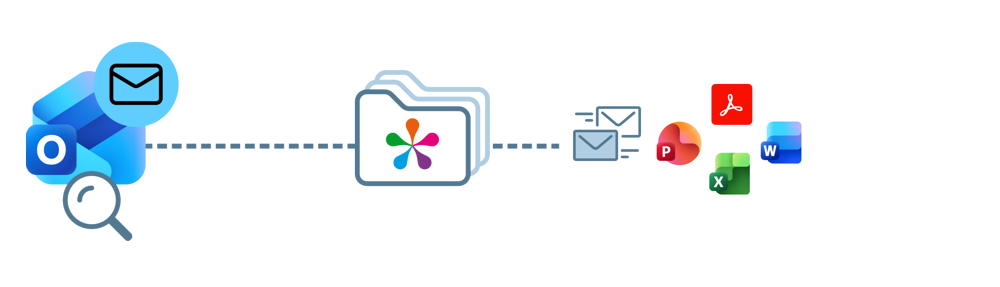
Knowledgemill works within Microsoft Outlook, allowing IT and business services teams to continue using their existing email environment without manually transferring every communication into another application.
As emails are sent and received, Knowledgemill analyses information such as the sender, recipients, conversation history, attachments and other contextual information to identify where each communication belongs.
For new conversations, Knowledgemill can suggest the appropriate customer, project, contract, service, supplier or department location. Replies and forwards can be recognised as part of an existing conversation and filed automatically, reducing the administrative workload for service and support teams.
Many organisations achieve around 80% automatic filing, with automation rates increasing over time.
The result is a structured, permission-based repository of business communications that can be searched, reused and managed as organisational knowledge rather than remaining isolated within individual inboxes.
"Very simply, we send and receive at least 30% less email."
William Jerram
Director, Jerram Falkus
Enterprise IT & Business Services-specific use cases
Internal and External Communications
Automatically organise important communications between employees, customers, partners and suppliers, helping teams maintain a clear history of conversations, decisions and actions.
Information Security
Manage relevant security communications, access requests, incident correspondence and other sensitive information within a structured and permission-based environment.
Projects and Service Delivery
Keep project discussions, technical decisions, approvals, delivery updates and supporting attachments connected to the appropriate project or service.
Contracts and Supplier Management
Maintain a complete record of communications relating to contracts, renewals, quotations, suppliers and third-party service providers, supporting effective commercial and operational management.
HR and Employee Communications
Support the structured management of relevant HR, employee and safeguarding communications while maintaining appropriate access controls.
Prepare Business Data for AI
Rather than asking AI systems to work with fragmented information scattered across individual inboxes, organisations can first establish a more organised and governed source of business knowledge.
Our Customers

Email Management for Enterprise IT & Business Services FAQs
Enterprise IT teams use email extensively for service requests, projects, supplier management, customer communications and operational decisions. Effective email management helps ensure important communications are securely retained, searchable and accessible to authorised employees.
Email management can automatically organise service-related conversations and associate them with the appropriate service, customer, project or department. This makes it easier for authorised teams to retrieve previous correspondence and understand the history of a request.
Yes. Knowledgemill helps organisations capture, organise and structure valuable information contained within email. This can provide a more accessible and governed source of organisational knowledge for AI search, knowledge assistants, automation and other AI initiatives.
A significant amount of organisational knowledge exists in unstructured email conversations and attachments. If this information remains fragmented across individual inboxes, it can be difficult to discover, govern and reuse. Organising email creates a stronger foundation from which organisations can identify and use business knowledge in AI initiatives.
Knowledgemill helps organisations organise the underlying email information that contains business knowledge. This can make relevant information easier to discover and provide a more structured source for enterprise search, knowledge management and AI applications.
Yes. By automatically organising emails and providing permission-based search across stored communications, Knowledgemill can reduce the time employees spend searching individual inboxes and asking colleagues to locate information.
Yes. Knowledgemill can organise project-related email conversations and attachments, helping teams maintain an accessible record of decisions, approvals, technical discussions and delivery communications.
Knowledgemill can automatically organise supplier correspondence relating to contracts, renewals, quotations, services and ongoing discussions. This makes communications easier to retrieve and can support supplier governance and audit processes.
Structured email management can help reduce reliance on individual inboxes and provide controlled access to centrally stored communications. Knowledgemill uses permission-based access to help ensure authorised users can access the information relevant to their role.
No. Knowledgemill complements systems such as IT service management platforms by managing the email communications and attachments surrounding service requests, incidents, projects and other activities. It helps ensure valuable information does not remain isolated in Outlook.
Yes. Knowledgemill works within Microsoft Outlook, allowing IT and business services teams to continue using their existing email workflows without manually transferring every communication into another application.
When important service, project or supplier knowledge exists only in an individual's inbox, it can be difficult for colleagues to access when that person changes role or leaves. Knowledgemill helps capture and organise relevant communications in a shared, permission-based repository, helping preserve organisational knowledge.